

Cascadia Sailing: Learn, Train, Progress, Repeat
48 North Article December 2025 by Jen Morgan Glass
Those following along on our Cascadia Sailing journey will know we came together as a team earlier this fall. For anyone just learning about us, we are a group of women from both sides of the border preparing for the New York Yacht Club’s inaugural Women’s International Championship, which will be sailed in the club’s IC37 performance boats in September 2026.
Since this team is made up of sailors from Washington and British Columbia, it reflects and celebrates our unique sailing region. So it feels right to include the sailing community of the Pacific Northwest in our process of preparation. We are excited to share stories and experiences as we train and come together as a team in the coming months.
Grand Prix Takeaways:
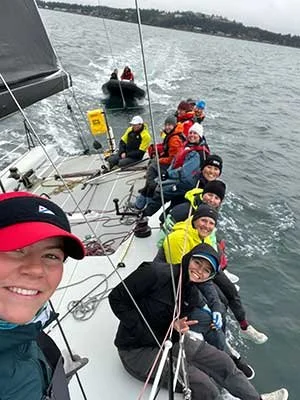
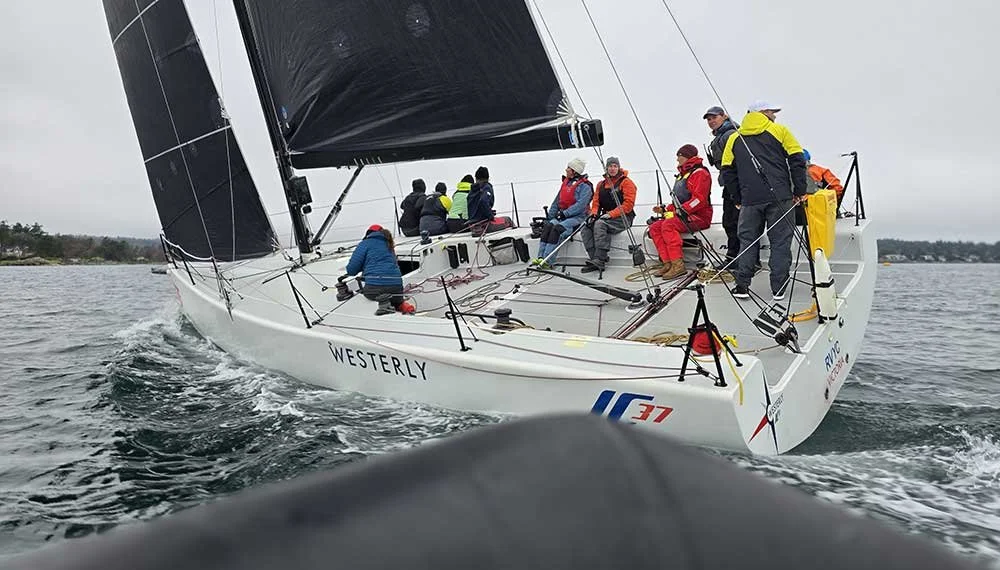
Our team is fortunate to be sailing and training on an IC37 that was recently acquired by Cascadia Sailing co-founder, Joy Dahlgren. She brought it down from its homeport at Royal Victoria Yacht Club for October’s Seattle Yacht Club Grand Prix Regatta, our first event together. Team Cascadia placed second in class, and we are stoked with our performance and finish! We felt this confirmed we did in fact build a strong and talented team, and our first practice sessions paid off.
The regatta also gave us the opportunity to identify key areas where we needed to improve, which we have used to focus our subsequent practice session. During Grand Prix, we frequently found ourselves near Farr 39 ML Absolutely, which has a similar rating. They are an impressive team, showing up well practiced, able to quickly tune into their settings and mode, with strong boat handling. They don’t give up much on the race course. Evaluating ourselves alongside such a consistent performer helped us identify three preliminary training goals.
Our Goals:
Goal 1:
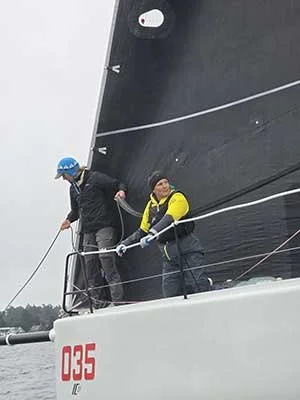
Start strong. We weren’t yet comfortable with our starting process. We need to be able to consistently position our boat in the correct spot on the line, and then be able to accelerate to hit the line at full speed. At Grand Prix, we looked a bit like Bambi learning to skate. We weren’t yet on the same page as a team regarding when the sails needed to come in to accelerate and what angle we should sail for best acceleration. Our starting team of tactician, time and distance callers, skipper, main and jib trimmers, and bow person all had slightly different visions of how it would all go. Not effective, but also expected for a brand new team. Getting races underway more efficiently was certainly on top of our practice list.
Goal 2:
Maintain max VMG. The IC37 is a quirky boat, and the mode changes can come fast at times, particularly upwind. The boat likes a very flat jib when powered up, but if you miss the cue to repower (responding with both sails and some tiller), the change needed in the jib to get the boat going again was much larger than any of us expected. We kept finding ourselves missing the cues when sailing into a lull, slowing down by a knot or more, and taking too long (more than a minute) to get back up to speed. We knew we could do better. We want to see our speed only drop by a few tenths and come back up to target in less than 10 seconds in similar situations.
Goal 3:
Smooth out the corners. We needed to smooth out our mark roundings. The very shifty easterly slant at Grand Prix required a number of quick set-then-jibe hoists, and high-angle drops. These advanced maneuvers challenged our team, which is both new to the boat and new to each other. It is reasonable that it would take some time to perfect these maneuvers, but our whole team shares a vision of being able to elegantly pull off any mark rounding that comes our way.
Getting The Process Cooking:
In the recipe for improvement, there are a few simple ingredients: set goals, pick effective drills, and make time to practice. You can’t get to the next level in just a single practice, but you absolutely can make significant improvement in a few hours on a single day. Continuing to build on of these improvements will turn good into great. The dish is enhanced by having a great coach.
We took our goals from Grand Prix into our scheduled practice weekend in mid-November. Team Cascadia traveled from our respective homes and assembled in Victoria, where out-of-towners benefitted from the generous hospitality of Victoria-based teammates. We were lucky to have two coaches for these training sessions: Ben Mumford, former owner of Joy’s IC37 and skipper of Royal Vancouver YC’s 2025 NYYC Invitational Cup team that placed third amongst world-class competition; additionally we were joined by Fraser McMillan, Royal Vic local, talented Melges and 470 campaigner, and all-around excellent sailor.
Having a coach, even for intermittent practice sessions, is an amazing accelerator as they bring their own experience and a fresh set of eyes to your team. Moreover, the tactician (my role on Team Cascadia) often acts as de facto practice coordinator, so a coach takes this off of my plate. Being able to devote my full focus toward this team improvement is important for my own growth, so I am particularly grateful for Ben and Fraser’s dedication of time.
First Goal:
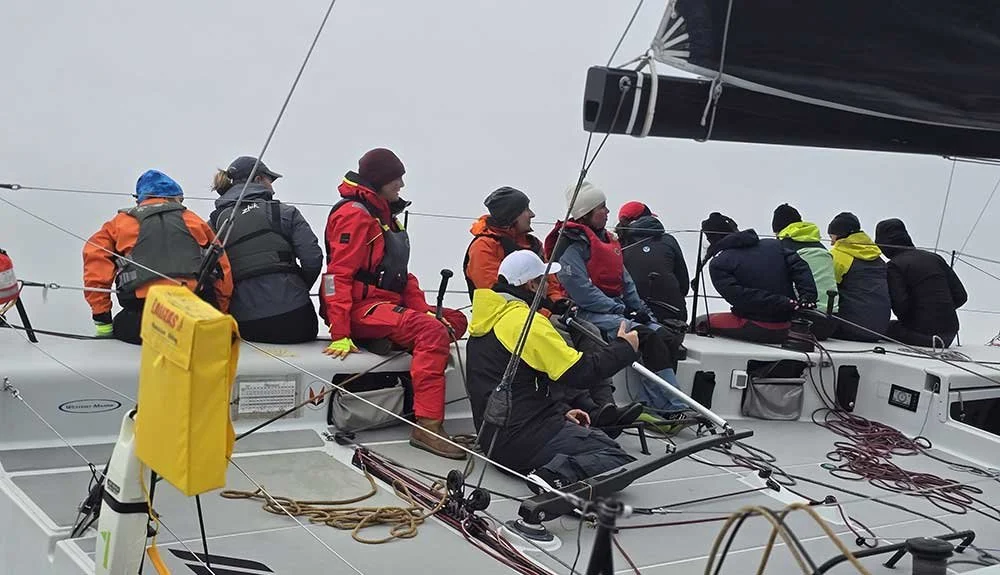
We started out on Saturday focused on Goal 1: Start strong. Fraser set up a starting line just a few minutes sail from the Royal Vic docks, and we practiced starboard approach starts. In my experience, it’s helpful to be extremely specific with practice drills. We set up at 3 minutes on port and practiced picking the right time to tack back to starboard, reach to our target distance from the line, then hold a slow and high approach, selecting the right time to accelerate and cross the line. We spent 2 hours on this drill with Ben onboard the boat giving real-time coaching and feedback, and Fraser in the coach boat with one of our teammates filming for our end-of-day debrief. It was intense, but incredibly valuable.
After a couple of hours, we had our vocabulary nailed down for clear communication, and we had reduced the time it took us to accelerate from 4 to 7 knots by half. While it might sound tedious to spend that much time rehearsing the minutia, the results were phenomenal. I promise it goes by faster than you think. We’ll likely do this drill, or a similar drill with a port-tack approach, every time we practice.
Second Goal:
Next up was Goal 2: Maintaining max VMG. Our drill for this goal involved sailing upwind with a laser focus on target heel and boatspeed. The goal is to see how long you can hold your exact target numbers. We made our way out into Haro Strait so we had some open water to stretch our legs. Ben provided valuable feedback on sail trim adjustments whenever we deviated from the targets. We also worked on concise and clear communication between our wind caller, trimmers, and skipper, so everyone was on the same page as we crossed from underpowered to overpowered and back again.
It was important to communicate what adjustments were being made, such as “traveler down one” or “runner at max” in real time. Simple as it is, the act of communicating the target speed and heel—and the actions that affect those aspects of performance—keeps everyone engaged in the process of achieving our VMG goal. Still, long boatspeed sessions can get boring for those who are not on the speed team. I break up the long straight lines by keeping an imaginary race going in my head, fitting in some boat handling practice while balancing time for the speed team to work through puffs and lulls. Call me cheesy, but I often call out “oh, a boat just tacked, we’re lee-bowing, tacking in 2, 1…” This has the added benefit of keeping everyone warm in November in the PNW.
Goals 1 and 2 were plenty to keep us occupied during this practice session. Back ashore, we reviewed the video during our debrief, both cementing our lessons for the day and showing us the improvements we had made. The debrief is another place where a coach can really benefit the team’s growth, highlighting the most important themes and progress.
ON THE HORIZON
Our goal between now and September is to practice at least once per month, and a bit more during the summer months when there will be more events and longer days. Since some of the team has to travel wherever we meet, we have committed full weekends for practice to maximize our on-the-water value for the given travel time. In between practices and events we share thoughts, articles, and discuss videos between the team.
